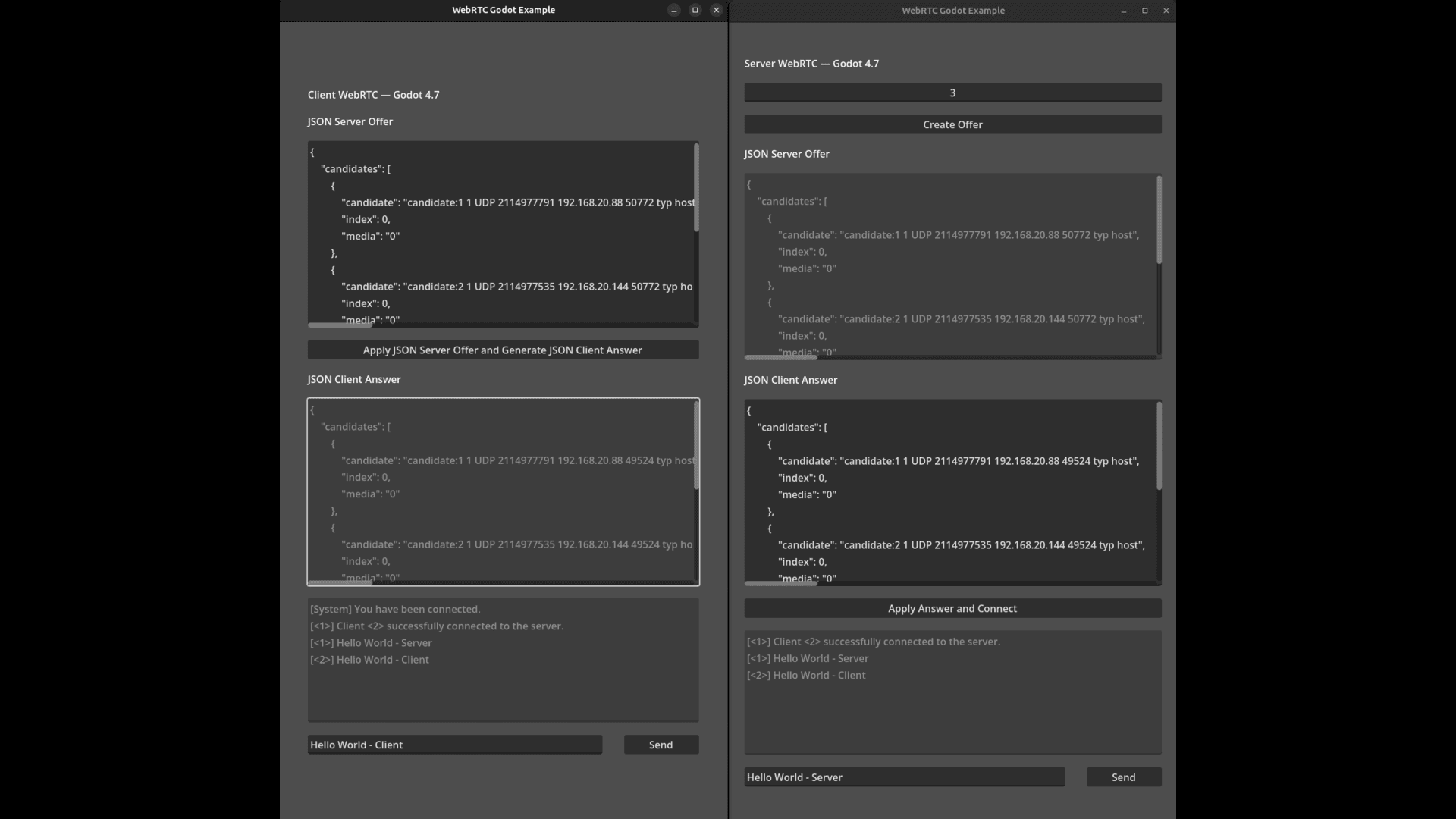
Godot WebRTC Protocol - Demo
Overview
Godot WebRTC Protocol is an educational demo project built with Godot 4.7 that demonstrates how to establish WebRTC connections and exchange messages between a server and multiple clients.
WebRTC can be challenging to understand when you are first learning multiplayer networking. Concepts such as SDP offers and answers, ICE candidates, signaling, peer connections, and data channels can make the initial learning process confusing.
This project aims to make these concepts easier to understand through a practical, interactive example using GDScript and Godot's WebRTC functionality.
This is a standalone demo project, not a Godot plugin.
Features
- Server and client architecture: Explore how a server and multiple clients participate in establishing WebRTC connections.
- SDP offer and answer exchange: Inspect the connection negotiation data exchanged between peers.
- ICE candidate exchange: Examine the network candidates used during connection establishment.
- Multiple clients: Connect multiple clients to the same server and observe their communication.
- Real-time messaging: Send and receive text messages after establishing a connection.
- Interactive interface: View the generated connection data and test the connection workflow directly through the demo.
- Godot 4.7: Built as a practical example for developers working with this version of Godot.
How It Works
1. Signaling
Before two peers can communicate through WebRTC, they need to exchange connection information. This process is called signaling.
The peers exchange Session Description Protocol (SDP) information, including offers and answers, and the ICE candidates required to negotiate a network path.
Signaling is responsible for exchanging this information. It does not inherently carry the application's gameplay data.
2. Establishing the Connection
The server and each client create their WebRTC peer connection and exchange the required negotiation data.
Once the connection has been successfully established, the peers can communicate through WebRTC data channels.
The signaling mechanism and the WebRTC data connection serve different purposes: signaling coordinates connection setup, while the established peer connection carries application data.
3. Communication Between Server and Clients
The demo allows multiple clients to connect to the server and exchange messages.
You can observe the connection information, follow the negotiation workflow, and send messages to see how communication works after the connection is established.
This provides a foundation for understanding how WebRTC can be used in multiplayer game prototypes and other real-time applications.
What You Can Learn
This project is intended for developers who want to understand the practical aspects of WebRTC before integrating it into their own games.
By exploring the example, you can learn about:
- The roles of SDP offers and answers.
- Why ICE candidates must be exchanged between peers.
- The purpose of a signaling mechanism.
- How WebRTC peer connections are established.
- How multiple clients can participate in a multiplayer architecture.
- How to exchange application messages over WebRTC data channels.
- The difference between connection negotiation and communication after connection establishment.
Getting Started
- Download or clone the repository.
- Open the project in Godot 4.7.
- Run the project and inspect the server and client interfaces.
- Follow the offer, answer, and ICE candidate exchange workflow.
- Establish the connections and test message exchange between the server and connected clients.
Refer to the repository README for project-specific setup instructions and additional details.
Important Networking Notes
WebRTC connection establishment depends on the network environment and the signaling workflow.
A successful local test does not guarantee that connections will work across every network. NAT behavior, firewalls, and network restrictions can affect connectivity. STUN and, when necessary, TURN infrastructure may be required for connections across different networks.
The signaling exchange shown in this demo should be understood as a learning example, not as a complete production-ready matchmaking, authentication, or relay service.
Intended Audience
This project is suitable for:
- Godot developers learning multiplayer networking.
- Indie game developers exploring peer-to-peer communication.
- Developers experimenting with WebRTC and GDScript.
- Anyone looking for a practical starting point for understanding WebRTC signaling and data exchange.
Source Code
GitHub repository:
https://github.com/AchcarLucas/WebRTC-Godot-Example
Contributions, suggestions, and feedback are welcome.
The goal of this project is to make WebRTC easier to understand by providing a practical example that developers can explore, run, and adapt for their own experiments.
Changelog for version Godot WebRTC Protocol - Demo - v1.0.1
2026-10-16 14:41:00
No changelog provided for this version.