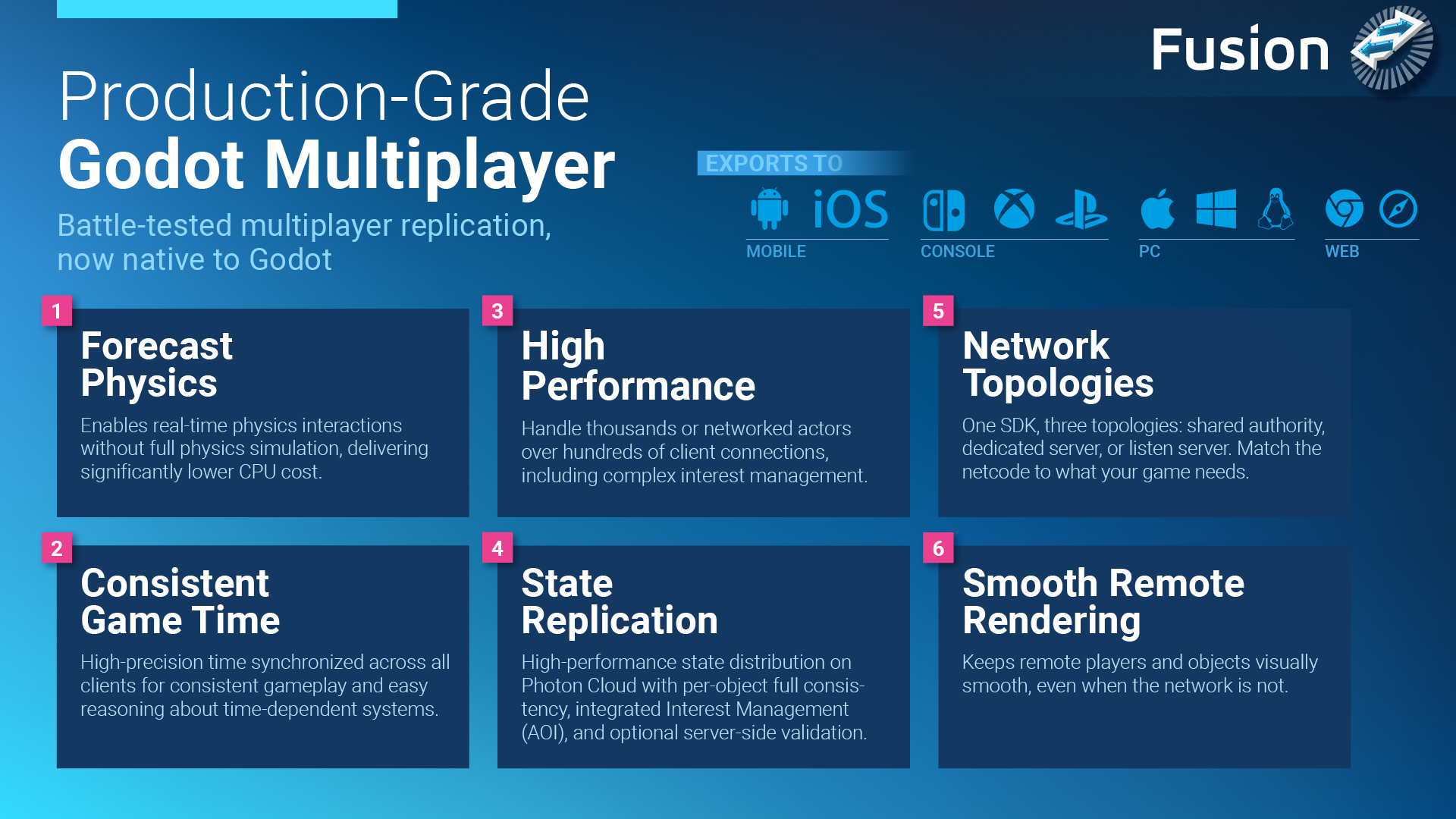
Photon Fusion is a state-sync multiplayer SDK that simplifies networking best practices and brings advanced features of modern AAA multiplayer games to Godot. Fusion gives teams a single SDK that can cover co-op friendslop, physics-driven games, massive multiplayer, esports and server-authoritative multiplayer, depending on the trust model and hosting approach a project needs.
Free for 100 CCU, Fusion is designed to feel native inside Godot. It is delivered as a GDExtension addon that works with the stock engine, and its integration layer is built around regular nodes in the scene tree. Depending on topology, developers use FusionSharedReplicator or FusionServerReplicator while continuing to work with scenes, nodes, signals, inspector-based setup, GDScript, and optionally C# with Godot .NET.
Fusion is built on the Photon Cloud, which powers thousands of live games, giving you matchmaking, late join, flexible RPCs and the choice between Shared-Authority (No Server Required) and Client-Server (either dedicated servers or player-hosted games).
At the core, Fusion replicates the state at the property level. Authorities write the definitive values for node properties, Photon Cloud syncs only the changed values, and late joiners automatically receive the current world snapshot. In Shared-Authority, each client owns and simulates its own nodes locally. In Client-Server, a simulation server is the sole authority for state changes while clients can still predict locally and receive corrections when the authoritative state snapshot arrives. Photon Cloud handles connection flow, matchmaking, and room management across 20 endpoints worldwide, including China.
Fusion also improves the feel of networked motion. Forecast Physics for RigidBody2D and RigidBody3D uses velocity-based forecasting and smooth correction, while CharacterBody and other nodes can use automatic smoothing.
Interest Management limits updates to relevant objects only, helping larger scenes and denser sessions scale more cleanly. It supports both transform-based Areas of Interest and custom tagging for interest.
For gameplay events, Fusion supports flexible RPC workflows that fit naturally with Godot. Object-targeted and broadcast RPCs can be sent through Fusion, with support for calling everyone, specific targets, owners, or master-client-driven logic. This makes it easier to build abilities, combat events, chat, interactions, and other one-shot gameplay actions alongside a continuous replicated state.
Photon Fusion for Godot is a strong foundation for teams building co-op, friendslop, mobile F2P, XR, WebGL, large-scale games, networked physics, esports or server-authoritative online play in Godot. It combines Photon Cloud infrastructure with a Godot-native integration model, so developers benefit from a high-performance multiplayer core and don't have to rebuild matchmaking, replication, smoothing, late-join handling, large-scene synchronization, and much more from scratch.
📄 USEFUL LINKS 📄
Core capabilities
Forecast Physics
Fusion for Godot includes Forecast Physics prediction for RigidBody2D and RigidBody3D, as well as smoothing for CharacterBody and other networked nodes. For physics-driven gameplay, Fusion uses remote state, velocity, and controlled correction to keep object motion feel much closer to gameplay, rather than obvious snapping or delayed correction.
Forecast Physics makes a real difference for multiplayer games built around movement, collisions, vehicles, interactable props, or shared world objects. Fusion can also auto-detect the root node type and apply the appropriate sync strategy, reducing setup time and making networked motion easier to tune.
Three Multiplayer Topologies
Photon Fusion supports Shared-Authority and Client-Server modes across Shared-Authority, Client-Host, and Dedicated Server topologies. This lets teams choose the trust model, hosting approach, and operational footprint that fit the game without changing SDKs.
Choose Shared-Authority for co-op, casual, social, or physics-driven multiplayer gameplay without a dedicated fleet, or Dedicated Server when centralized simulation and match reliability matter most.
Godot-Native Integration
Fusion is delivered as a GDExtension addon for the stock Godot engine. FusionSharedReplicator and FusionServerReplicator are regular child nodes, so teams keep working with scenes, nodes, signals, inspector-driven setup, GDScript, and optional C# with Godot .NET instead of adopting a separate gameplay framework.
Consistent Game Time
Fusion is designed around a synchronized time-based multiplayer simulation, providing developers with a consistent timing model for all objects across clients. Fusion stays consistent over time, even during ownership transfer, with maximum jitter. That matters for gameplay systems where timing is critical, including movement, interactions, effects, cooldowns, and other time-sensitive mechanics.
Consistent game time makes multiplayer behaviour easier to reason about and build on.
Interest Management
Fusion comes with built-in area-based spatial filtering and custom interest keys, ensuring clients receive only relevant updates and enabling smooth scaling to dozens or even hundreds of players by design. Instead of broadcasting every replicated object to every connected player, the server can limit state distribution based on spatial relevance or custom interest.
Interest Management helps larger levels and denser sessions scale more cleanly by reducing unnecessary traffic and avoiding wasted updates on distant or irrelevant objects. Photon Fusion is not only optimized for the CPU but also for bandwidth.
Custom RPCs for Gameplay Events
Fusion supports RPCs for one-shot gameplay events that should not live in the replicated state buffer, such as abilities, damage events, triggers, interactions, and chat-like messages. You can use both object-targeted and broadcast RPC patterns, with support for sending to everyone, a selected target group, or a specific player. Fusion also supports most Godot built-in types, including networked node references.
The clean split between continuous synchronized state and event-driven gameplay messaging is exactly what is needed to simplify responsive online mechanics.
QoS / Global Regions / DDoS / SLA
Backed by managed online infrastructure instead of raw peer connections alone.
Important for latency, reliability, and live operation at scale.
High Performance
Designed to handle dense multiplayer scenes with less CPU and memory overhead.
Matters when actor counts, player counts, or update frequency start climbing.
📄 USEFUL LINKS 📄
Photon Fusion is Free for 100 CCU. Select the 100 CCU Free plan using +/- in your app dashboard.
🤝 Photon Circle 🤝
Join the conversation and become a part of an exclusive community by engaging with the Photon Gaming Circle. Kickstart your project with a robust foundation that enables limitless creativity with 110+ exclusive samples across engines. Benefit from our fully networked samples to save time and resources while ensuring the highest quality for your project.
Members of the Gaming Circle not only have access to all the samples but also to our latest SDKs, our private Circle Discord, and premium development support. The Photon Gaming Circle is a hub for developers to discuss ideas, seek advice, and collaborate on exciting projects. Dive deeper into multiplayer game development and explore the Photon Gaming Circle today.
This product is governed by the Photon Engine license terms.
Changelog for version 3.0.0-preview-517
2026-07-02 13:02:12
No changelog provided for this version.