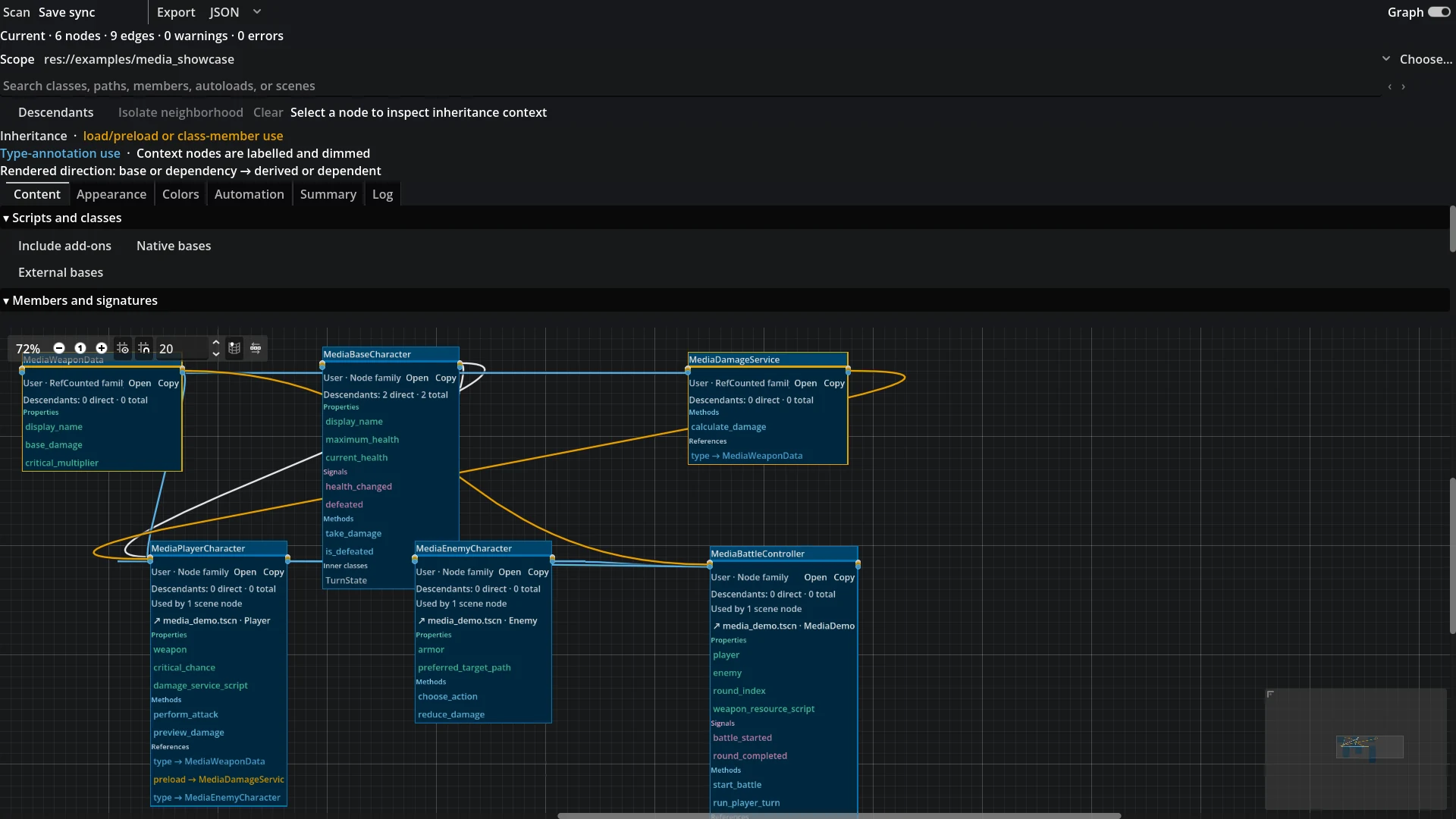
Script Dependency Inspector scans saved GDScript source without loading analyzed project scripts for reflection or instantiating project classes. It validates one canonical dependency snapshot and makes that evidence available both inside Godot and as portable files.
Inspect inside Godot
- Visualize path-based,
class_name, native, add-on, and unresolved inheritance. - Distinguish literal
load()/preload(), type-annotation, and statically resolvable class-qualified member dependencies. - Hover a connection for its canonical dependent/dependency direction, exact evidence kind, source/member provenance, and represented occurrence count.
- Hover compact member rows for full signatures/declarations, exact declaration locations, and static incoming/outgoing evidence counts.
- Search classes, paths, members, autoloads, scenes, and scene-node paths.
- Navigate to exact supported declarations, dependency occurrences, and text-scene attachments.
- Select project-folder scopes while retaining required outside context.
- Focus inheritance paths, include descendants, or isolate a bounded relationship neighborhood.
- Use grouped foldable controls rather than one long flat option list.
Export for dedicated diagram and documentation tools
The built-in GraphEdit is optimized for inspection inside an editor dock. It is not the only viewing surface. Export the same validated snapshot as:
- JSON — lossless structured data for automation, custom analysis, or custom renderers;
- Mermaid — portable text diagrams for documentation systems and Mermaid-compatible editors/renderers;
- PlantUML — class diagrams for PlantUML tools with precise member endpoints where supported.
Dedicated third-party applications can provide a larger canvas, different layout engines, renderer-specific themes, publication workflows, or presentation controls that are impractical in a constrained editor dock. The graph can therefore be hidden entirely while scans, synchronization, summaries, diagnostics, and manual or automatic exports continue to operate.
Stay synchronized
Save/import synchronization is enabled by default and debounced after editor activity becomes quiet. The toolbar shows whether scanning is save-synchronized, timed, both, or manual. Timed rescanning remains an independent disabled-by-default fallback. JSON, Mermaid, and PlantUML destinations can be updated independently after each completed scan.
Reliability boundary
- Deterministic ordering and versioned snapshot schema
- Validation before every serialization
- Bounded files, directories, scripts, and text scenes
- Recoverable staged writes and independent per-format failures
- Actionable validation diagnostics with stable issue codes, selected scan root, and bounded structured context
- Failed rescans preserve the last valid graph as an explicitly STALE, inspection-only snapshot with the failure reason and last-success timestamp; export remains blocked until a successful rescan
- Validator services recover after editor script lifecycle/hot-reload invalidation instead of exposing a recoverable
validator_unavailablestate - Explicit diagnostics instead of guessed dynamic relationships
- Automated behavioral, negative, export, visual, performance, and compatibility tests
Compatibility
Runtime-tested against the supplied Linux builds of Godot 4.3, 4.4.1, 4.5.2, 4.6.3, and 4.7. Consult the included compatibility matrix for the exact executed evidence.
Static-analysis limits
This is not a runtime profiler or complete call graph. It does not infer aliases, dependency injection, virtual dispatch, reflection, dynamic paths, runtime-selected receiver types, binary-scene contents, or transitive scene/resource behavior. Missing evidence is omitted or diagnosed rather than guessed.
AI-assisted development disclosure
Generative AI was used extensively for requirements synthesis, code and refactoring drafts, tests, documentation, diagrams, review suggestions, and release support. The project owner directed scope and feature decisions. AI output was treated as proposed work and checked through documented contracts, review, Godot parser/import and runtime tests across the claimed engine matrix, negative and boundary tests, deterministic builds, checksums, patch reconstruction, and rendered-artifact inspection. This does not claim an independent human line-by-line audit or independent accessibility/security certification. Full details and provenance limits are in AI_USAGE_NOTICE.md.
Licensed under the MIT License.
Changelog for version v0.4.0
2026-08-30 12:41:13
No changelog provided for this version.